
Nuclear Thorium clocks can be make in solid small devices. Here are short, exam-ready notes on the topic:
Nuclear Clock using Thorium-229
- Atomic clocks work by counting electron transitions between atomic energy levels.
- Nuclear clocks aim to count transitions within the nucleus, which is better shielded from environmental disturbances → higher stability.
Why Thorium-229 (²²⁹Th)?
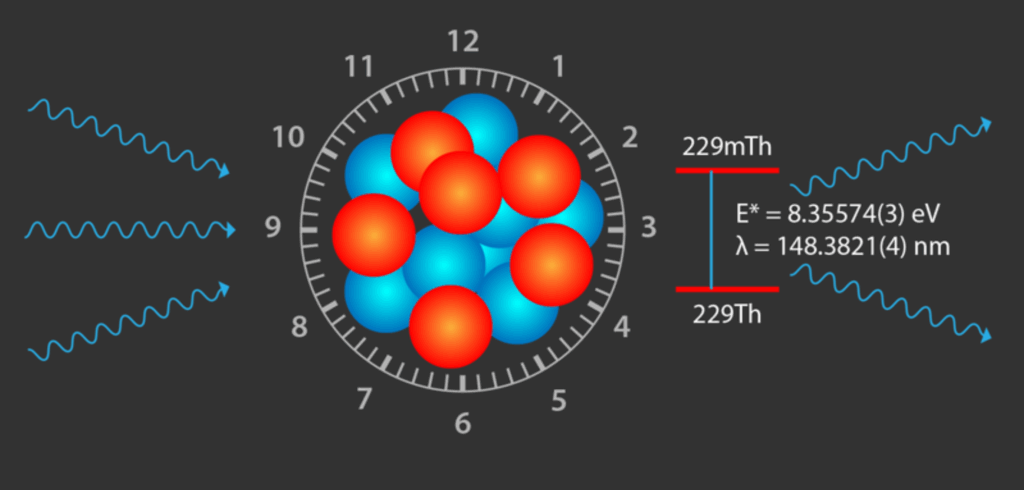
- Has a unique low-energy nuclear excited state (~8.4 eV above ground state).
- Energy is low enough to be excited directly using vacuum-ultraviolet (VUV) lasers.
- Ideal candidate for a nuclear clock.
Key Challenge
- In solids, excited thorium nuclei often relax via internal conversion:
- Energy is transferred to an electron, ejecting it.
- Little or no photon emission → hard to detect nuclear excitation directly.
New Experimental Breakthrough
- Researchers used internal conversion itself as a signal.
- Material used: Thorium dioxide (ThO₂) with band gap ~6 eV.
- Method:
- Excite nuclei using VUV laser pulses.
- Detect electrons emitted when nuclei decay.
- Suppress initial photoelectron burst using timed electric fields.
- Extract delayed electrons linked specifically to nuclear decay.
Key Results
- Clear nuclear resonance detected at 2,020,407.5 GHz.
- Internal conversion lifetime measured: 12.3 microseconds.
- Implies clock accuracy of:
- 1 second error in ~15.8 billion years.
Significance
Opens new ways to probe nuclear environments in materials.
Demonstrates feasibility of solid-state nuclear clocks.
Expands materials usable for high-precision timekeeping and sensing.
Enables miniaturisation:
Clock can be monitored via electron current, not complex optics.
- Nuclear energy levels of Thorium-229: diagram of the low-energy nuclear transition used for the clock.
- Schematic concept of a nuclear clock setup: laser + thorium nucleus + feedback loop.
- Artistic/illustrative depiction of how a nuclear clock works: showing nucleus and UV light interacting.
- Comparative schematic of frequency comb and the nuclear transition: placing Th-229 transition next to atomic clocks.
- Experimental apparatus sketches for thorium spectroscopy: part of a setup to measure the transition.
- Concept art of thorium nuclear clock + analog clock analogy: illustrative depiction of future devices.
Contact for more information. Facebook