
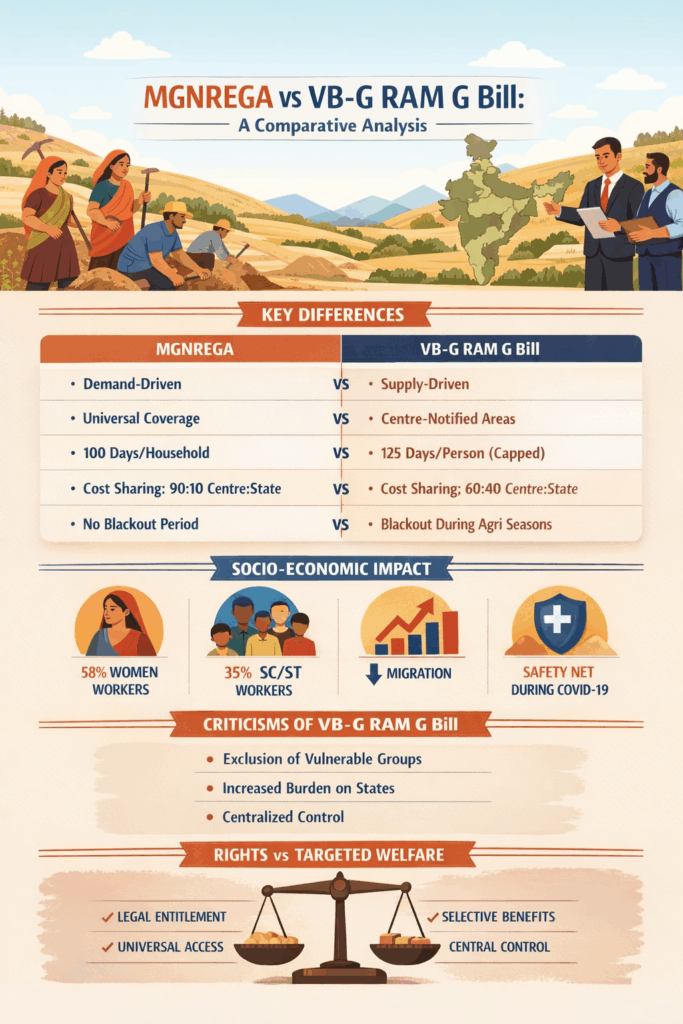
Alright — here is a more detailed, exam-ready expansion, still structured for UPSC GS II / GS III, with conceptual depth + analytical points you can directly lift into answers.
Replacement of MGNREGA by VB-G RAM G Bill – Detailed Notes
1. Context & Recent Development
- On December 18, Parliament passed the Viksit Bharat Guarantee for Rozgar and Ajeevika Mission (Gramin) Bill.
- The Bill replaces MGNREGA, 2005, a landmark rights-based rural employment law.
- Passed amid:
- Opposition walkouts and protests
- Criticism from civil society organisations
- Key allegation: absence of stakeholder consultation, which is ironic given MGNREGA’s participatory origins.
2. Evolution of MGNREGA: From Idea to Law
(a) Political and Institutional Origins
- Emerged after UPA’s 2004 victory
- Drafted under the National Advisory Council (NAC):
- Chaired by Sonia Gandhi
- Included activists, economists, retired civil servants
- Aruna Roy (MKSS) and Jean Drèze proposed:
- Right to Information
- Rural Employment Guarantee
(b) Initial Dilution & Civil Society Pushback
- Government draft diluted:
- Removed universality
- Introduced BPL targeting
- Allowed Centre to opt out
- Sent to Parliamentary Standing Committee on Rural Development
- Chaired by BJP leader Kalyan Singh
- Massive protests by:
- Right to Food Campaign
- Grassroots activists
- Committee restored:
- Universal coverage
- Legal guarantee
- Result: MGNREGA enacted in 2005
👉 Significance: Rare example of civil society shaping legislation.
3. Philosophy of MGNREGA
MGNREGA is built on three core principles:
(a) Rights-Based Approach
- Employment is a legal entitlement, not a welfare dole
- Failure to provide work → unemployment allowance
(b) Demand-Driven Nature
- Work provided on demand
- Budget must expand to meet demand
- Prevents arbitrary expenditure cuts
(c) Universality
- No caste, income, gender, or BPL criteria
- Anyone willing to do unskilled manual work eligible
4. Key Features of MGNREGA (Original Act)
- 100 days of guaranteed work per rural household
- Wage employment at statutory minimum wages
- Centre bears:
- 100% unskilled labour cost
- 75% material cost
- Mandatory provisions:
- Social audits
- Gram Sabha oversight
- Time-bound wage payments
- Assets created:
- Water conservation
- Drought proofing
- Rural connectivity
5. Socio-Economic Impact of MGNREGA
(a) Employment & Income Security
- 12.61 crore active workers
- Acts as:
- Shock absorber during agrarian distress
- Insurance against unemployment
(b) Women Empowerment
- Women participation: ~58% (last 5 years)
- Key outcomes:
- First independent income for many women
- Improved bargaining power within households
- Increased financial inclusion
(c) Impact on SCs & STs
- 35% workforce from SC/ST communities
- Consumption increase during lean season:
- Up to 30%
- Reduced dependence on moneylenders
(d) Migration Control
- Major reason for continuation:
- Prevention of distress migration
- Strengthened rural livelihoods locally
(e) COVID-19 Role
- Became largest safety net during lockdown
- Record employment generation
- Supported reverse migrants
6. Government’s Rationale for Replacing MGNREGA
Official Arguments
- Scheme allegedly:
- Riddled with corruption
- Misused by States
- Inefficient expenditure
- Need to align with:
- “Viksit Bharat” vision
- Asset creation + livelihood focus
Counter-Arguments
- Corruption is an implementation failure, not design flaw
- MGNREGA already has:
- Social audits
- DBT payments
- IT-based monitoring
- Weakening legal guarantees may worsen misuse rather than reduce it
7. VB-G RAM G Bill: Key Structural Changes
(a) Shift from Demand-Driven to Supply-Driven
- Employment provided only within:
- Fixed annual budget
- No guarantee that demand will be met
(b) Increased Workdays but Conditional
- 100 → 125 days
- However:
- Budget cap may nullify benefit
(c) Cost-Sharing Changes
- For most States: 60:40 (Centre:State)
- Earlier: ~90:10
- Financial stress for poorer States
(d) Centralisation of Power
- Centre decides:
- State-wise allocations
- Areas of implementation
- Scheme no longer universal
(e) Blackout Period
- Work can be paused during:
- Peak agricultural seasons
- Justification: labour availability
- Criticism: undermines income security during lean periods
8. Federalism Concerns
- Increased fiscal burden on States
- Reduced State autonomy
- Contradicts:
- Cooperative federalism
- Decentralised governance ethos of MGNREGA
- Gram Sabha role diluted
9. Rights-Based Welfare vs Targeted Welfare
| Aspect | MGNREGA | VB-G RAM G |
| Nature | Legal right | Government scheme |
| Accountability | Justiciable | Discretionary |
| Inclusion | Universal | Selective |
| Budget | Open-ended | Fixed |
| Governance | Bottom-up | Top-down |
India moving from rights-based welfare (2004–14) to targeted, centrally controlled schemes.
10. Implications for Rural India
Positive Claims
- More focused spending
- Better asset creation
- Alignment with agricultural cycles
Risks
- Exclusion of vulnerable households
- Reduced employment during crises
- Increased rural inequality
- Weakening of democratic accountability
11. Way Forward (Mains Value)
- Reform MGNREGA without dismantling its core:
- Strengthen audits
- Improve wage payment timelines
- Increase workdays per person (not household)
- Preserve:
- Universality
- Demand-driven nature
- Any reform must:
- Involve States
- Consult civil society
- Respect constitutional federalism
📌 One-Line Conclusion (for answers)
Replacing MGNREGA with a supply-driven, centrally controlled scheme risks diluting India’s most successful rights-based social security law.
For more information contact us. Facebook