
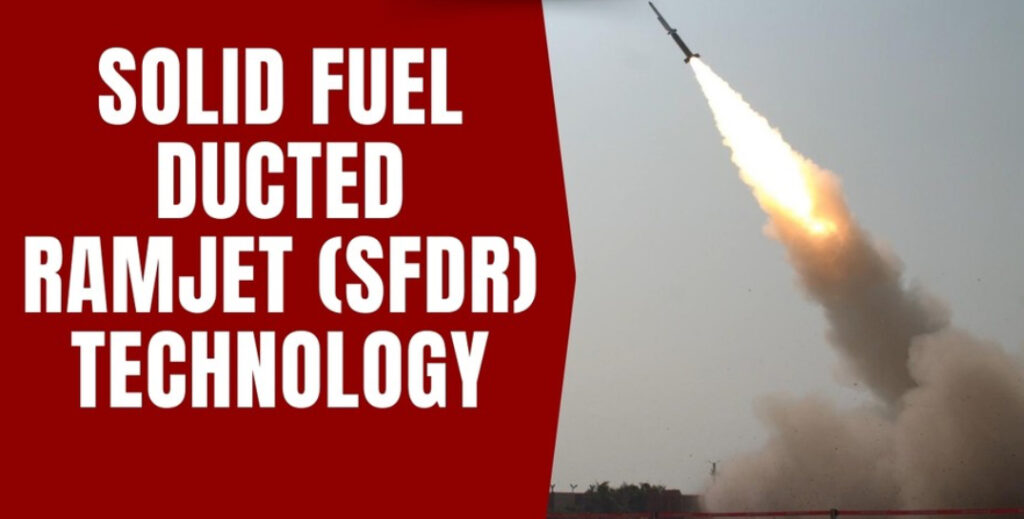
The Solid Fuel Ducted Ramjet (SFDR) technology is a cutting-edge advancement in missile propulsion systems that significantly enhances the range, speed, and manoeuvrability of modern missiles. Developed indigenously by India’s Defence Research and Development Organisation (DRDO), SFDR represents a major leap in air-breathing propulsion and places India among a select group of technologically advanced nations.
This technology is especially crucial for long-range air-to-air missiles, offering sustained thrust throughout the flight envelope—something conventional rocket motors struggle to achieve.
What is Solid Fuel Ducted Ramjet (SFDR) Technology?
The Solid Fuel Ducted Ramjet (SFDR) is an advanced air-breathing propulsion system that uses a solid fuel gas generator instead of liquid fuel. Unlike traditional rocket engines, SFDR does not carry an oxidiser, as it uses atmospheric oxygen for combustion.
This fundamental difference makes SFDR-powered missiles lighter, more efficient, and capable of maintaining high speeds over longer distances.
The technology has been developed by Defence Research and Development Laboratory (DRDL), Hyderabad, in collaboration with other DRDO laboratories, showcasing India’s growing self-reliance in advanced defence technologies.
Working of Solid Fuel Ducted Ramjet (SFDR)
The working mechanism of SFDR combines the advantages of solid fuel safety with the efficiency of ramjet propulsion.
1. Use of Solid Fuel Gas Generator
SFDR employs solid fuel instead of liquid fuel, making the system:
- Simpler in design
- Safer to handle
- Easier to store and transport
- More suitable for long-term military deployment
2. Air-Breathing Propulsion
Unlike conventional rockets:
- SFDR does not carry an oxidiser
- It uses oxygen from the atmosphere for combustion
This significantly reduces the missile’s weight and increases overall efficiency.
3. Sustained Thrust
Traditional rocket motors provide high thrust initially but burn out quickly. In contrast:
- SFDR provides continuous thrust over a longer duration
- It allows thrust modulation during flight, enhancing control and flexibility
4. Enhanced Flight Performance
Due to sustained propulsion:
- Missiles can fly faster and farther
- They remain highly manoeuvrable till the terminal phase
- Energy loss during mid-course is minimal
This makes SFDR-powered missiles extremely effective against agile aerial targets.
What is a Ramjet?
A ramjet is a type of air-breathing jet engine that:
- Relies on the missile’s high forward speed to compress incoming air
- Eliminates the need for complex compressors or turbines
- Becomes efficient at supersonic speeds
In a ramjet:
- Air enters the intake at high speed
- It is compressed naturally due to forward motion
- Fuel is injected and ignited
- Hot exhaust gases generate thrust
Since ramjets cannot operate from a standstill, they are usually combined with a booster motor, after which the ramjet takes over.
Significance of Solid Fuel Ducted Ramjet (SFDR) Technology
1. Enhances Long-Range Air-to-Air Missiles
SFDR provides sustained propulsion through much of the missile’s flight, giving:
- Longer engagement ranges
- Higher end-game energy
- Better kill probability
This is a game-changer for Beyond Visual Range (BVR) combat.
2. Superior Manoeuvrability
Continuous thrust allows missiles to:
- Perform sharp manoeuvres
- Counter evasive actions by enemy aircraft
- Maintain speed even during terminal interception
3. Strategic and Tactical Advantage
SFDR places India in an elite league of nations possessing this advanced propulsion technology. It enhances:
- Deterrence capability
- Air superiority
- Indigenous defence manufacturing under Atmanirbhar Bharat
4. Reduced Dependence on Imports
Indigenous SFDR development reduces reliance on foreign missile technologies, strengthening India’s strategic autonomy.
Conclusion
The Solid Fuel Ducted Ramjet (SFDR) technology marks a significant milestone in India’s defence and aerospace capabilities. By combining the safety of solid fuel with the efficiency of air-breathing propulsion, SFDR enables missiles to achieve greater range, sustained speed, and superior manoeuvrability.
Its successful development by DRDO not only enhances India’s military preparedness but also establishes the country as a global leader in advanced missile propulsion systems. As aerial warfare increasingly demands long-range and high-precision engagement, SFDR technology provides India with a decisive technological edge.